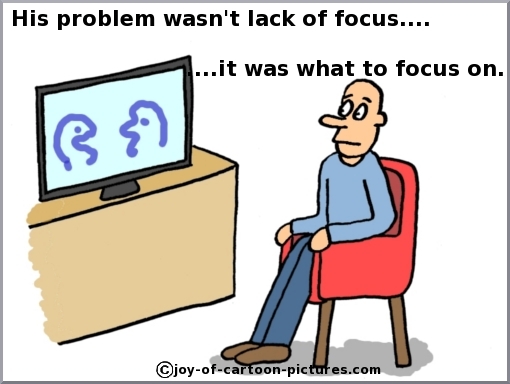
Can you
make it through this article in entirety without tending to your Facebook
notifications from your phone, switching to another tab on your internet
browser or thinking about what’s for lunch/dinner/supper later?
Virtual
cookies for you if you can, but I’m betting you aren’t going to get them.
Being
physically present, but mentally elsewhere, a state known as autopilot, is a
common problem these days, especially given the omnipresence of social media
and multimedia entertainment. While one may argue that getting a little break
or harmless day dreaming can help to inspire new ideas, in truth, this is a
major cause for procrastination. Spending too much time in your imaginary
paradise can in the long run lead to anxiety (from not completing your work)
and depression (at reality, or failure to achieve).
More
importantly, if you don’t focus on things that matter, they will be just be
random things that you bypass in life on a daily basis, rather than adding
value to your life. Do you sometimes find that you have trouble remembering and
describing things, names and faces that should matter? Maybe it’s because your
mind is on a bazillion other things.
The common
excuse of “I can’t focus” is in fact, just an excuse.
When
performing tasks, our brain’s reflex response to our usual mode is the focus
mode. If you’re in the middle of doing your work, and possibly multi-tasking
with something else inessential or in Lala-land, and you heard someone yell
“Fire!”, chances are, you’d drop whatever you’re doing, stick your head out of
your dream world and concentrate on finding out what this fire is about. It’s
unlikely that you’d start fiddling with your Facebook, unless you’ve made
certain that the situation is not dangerous for you.
The fact
is, many of us are capable of focusing on the things that matter. We are just not
using this ability to its full potential. If we could just utilize this ability
to give strict attention to the task at hand, imagine how much we could achieve,
and how much more time we can enjoy for guilty pleasure.
Certainly,
telling oneself to focus is easier said than done, and the common
recommendation of rewarding oneself after the task is done may often lead to
thinking about this reward in the middle of work instead, which becomes
counter-productive.
Meditation is a tried and
tested solution to help focus the mind and even alleviate stress and anxiety.
Here are three simple ones that anyone can do, any time, anywhere.
Walking meditation.
This conventional meditation method is recommended by
recommended by Catherine Kerr, director
of translational neuroscience at
Brown
University's
Contemplative Studies Initiative.
All you need is an empty space, the more spacious, the better, preferably
with nobody and nothing to get in your way. With no shoes on, but preferably
with socks, simply walk at a slow or medium pace, focusing your attention on
your foot. Yes, this will be a challenge for us fast-footed Singaporeans, but
you’ll soon get used to it. Instead of merely walking mindlessly or thinking of
something else, concentrate on the feel of your fet interacting with the ground
i.e. when your heel touches down, when your sole is flat on the ground, when
your toes point back upward.
If your mind wanders, gently bring your attention back into focus mode on
your feet.
Doing this helps you notice when your attention drifts our of focus, and to
bring it back into focus. With more practice, you will soon become more aware
and in control of your attention.
Once you become comfortable with pulling in and out of your
attention-deficit mode and focus mode, you can try it outside, on your way to
school, work, supermarket or just about any time.
Reflect on things that matter
Amit Sood, author of "The Mayo Clinic Guide to Stress-Free
Living," and director of research and practice at the Mayo Clinic
Complementary and Integrative Medicine Programme, suggests making paying
tribute to the people who matter to you the first thing you do when you wake
up.
With your eyes shut, think of the first person you feel grateful too. Bring
that person's face in front of your eyes and focus on one part of their face
that you really like.
Send them a "silent gratitude”, as Sood calls it, or "just a note of
thankfulness that this person is in your life. Do this for a second, third,
fourth and fifth person – perhaps someone who has died. Picture them happy; try
to imagine the colour of their eyes.
If you are finding it difficult to focus or remember certain facial aspects
of said person, perhaps too much is getting in the way when you’re spending
time with that person. In that case, if it isn’t too late, this is a sign that
you should spend more time with him or her, and give them more of your
attention.
You can also extend this beyond people to things like places, travel
locations that you have been to before or even TV programmes that you have
watched, even your favourite idol (Just don't get too obsessive).
These “silent gratitude”s not only help to train your ability to focus, but
also enables you to connect with people and things that you have not really
been in touch with. Quoting Sood - “you start feeling like you're not missing out
on life.”
Giving in to distractions is part of human nature, so if you find it
difficult to gain focus, don’t feel distressed or try to pressurise yourself
into focusing. Be compassionate and slow but steady, and you will eventually
regain the ability of being in control.